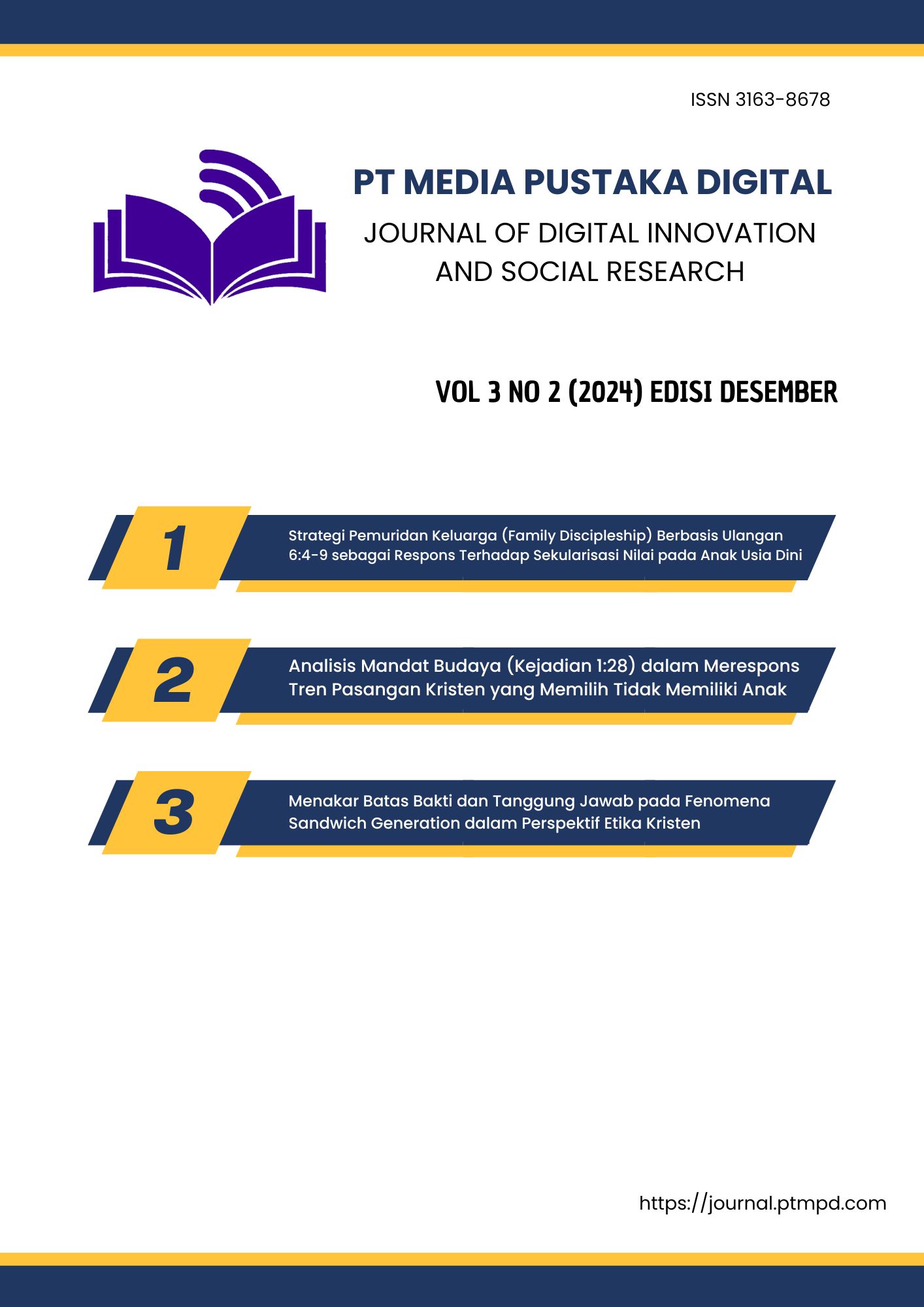
An Analysis of the Cultural Mandate (Genesis 1:28) in Responding to the Trend of Christian Couples Choosing to Be Childfree
DOI:
https://doi.org/10.5281/zenodo.21731558Keywords:
childfree, genesis 1:28, cultural mandate, procreation, christian ethics, christian familyAbstract
The phenomenon of childfree—the conscious decision of a married couple not to have children—has become a global trend that is now penetrating Christian communities in Indonesia. This choice is often driven by economic reasons, ecological anxiety, or the desire to pursue self-actualization. However, this trend sparks serious theological debate regarding the nature of Christian marriage. This article aims to evaluate the childfree phenomenon through the lens of biblical theology, specifically the analysis of the cultural mandate in Genesis 1:28. Using a descriptive qualitative method and a grammatical-historical exegetical approach, this study finds that having children is not merely a biological option, but a participation in God's creative work (procreation). Although the Bible does not make procreation the sole purpose of marriage, the rejection of offspring based on motives of selfishness or fear of the future is a deviation from God's design. This article offers an ethical perspective that "fruitfulness" must be understood holistically, yet rejects childfree as a normative lifestyle for believers.
Downloads
References
Ash, Christopher. Marriage: Sex in the Service of God. Vancouver: Regent College Publishing, 2003.
Bauman, Zygmunt. Liquid Love: On the Frailty of Human Bonds. Cambridge: Polity Press, 2003.
Bonhoeffer, Dietrich. Letters and Papers from Prison. New York: Macmillan, 1972.
Blackstone, Amy. Childfree by Choice: The Movement Redefining Family and Creating a New Age of Independence. New York: Dutton, 2019.
Crouch, Andy. The Life We're Looking For: Reclaiming Relationship in a Technological World. New York: Convergent Books, 2022.
Frame, John M. Nature’s Case for God: A Brief Biblical Argument. Bellingham: Lexham Press, 2018.
Giddens, Anthony. The Transformation of Intimacy: Sexuality, Love and Eroticism in Modern Societies. Stanford: Stanford University Press, 1992.
Hastings, Ross. Echoes of Coinherence: Trinitarian Theology and Science Together. Eugene: Cascade Books, 2017.
Hoekema, Anthony A. Created in God's Image. Grand Rapids: Eerdmans, 1986.
Keller, Timothy, and Kathy Keller. The Meaning of Marriage: A Vision for What Marriage Is and Why It Matters (Updated Edition). New York: Penguin Books, 2021.
Köstenberger, Andreas J. God, Marriage, and Family: Rebuilding the Biblical Foundation (Second Edition). Wheaton: Crossway, 2010.
Moltmann, Jürgen. Theology of Hope: On the Ground and the Implications of a Christian Eschatology. New York: Harper & Row, 1967.
Mohler, R. Albert. The Gathering Storm: Secularism, Culture, and the Church. Nashville: Thomas Nelson, 2020.
Newport, Cal. Digital Minimalism: Choosing a Focused Life in a Noisy World. New York: Portfolio, 2019.
Pearcey, Nancy. Love Thy Body: Answering Hard Questions about Life and Sexuality. Grand Rapids: Baker Books, 2018.
Waltke, Bruce K. Genesis: A Commentary. Grand Rapids: Zondervan, 2001.
Downloads
Published
Issue
Section
License
Copyright (c) 2024 Demas Arendra, Theo Pilus Candra (Author)

This work is licensed under a Creative Commons Attribution 4.0 International License.
This journal provides immediate open access to its content on the principle that making research freely available to the public supports a greater global exchange of knowledge.
Articles published in JDISR are licensed under a Creative Commons Attribution 4.0 International License (CC BY 4.0). This license permits anyone to copy, redistribute, remix, transmit, and adapt the work, provided the original work and source are appropriately cited.