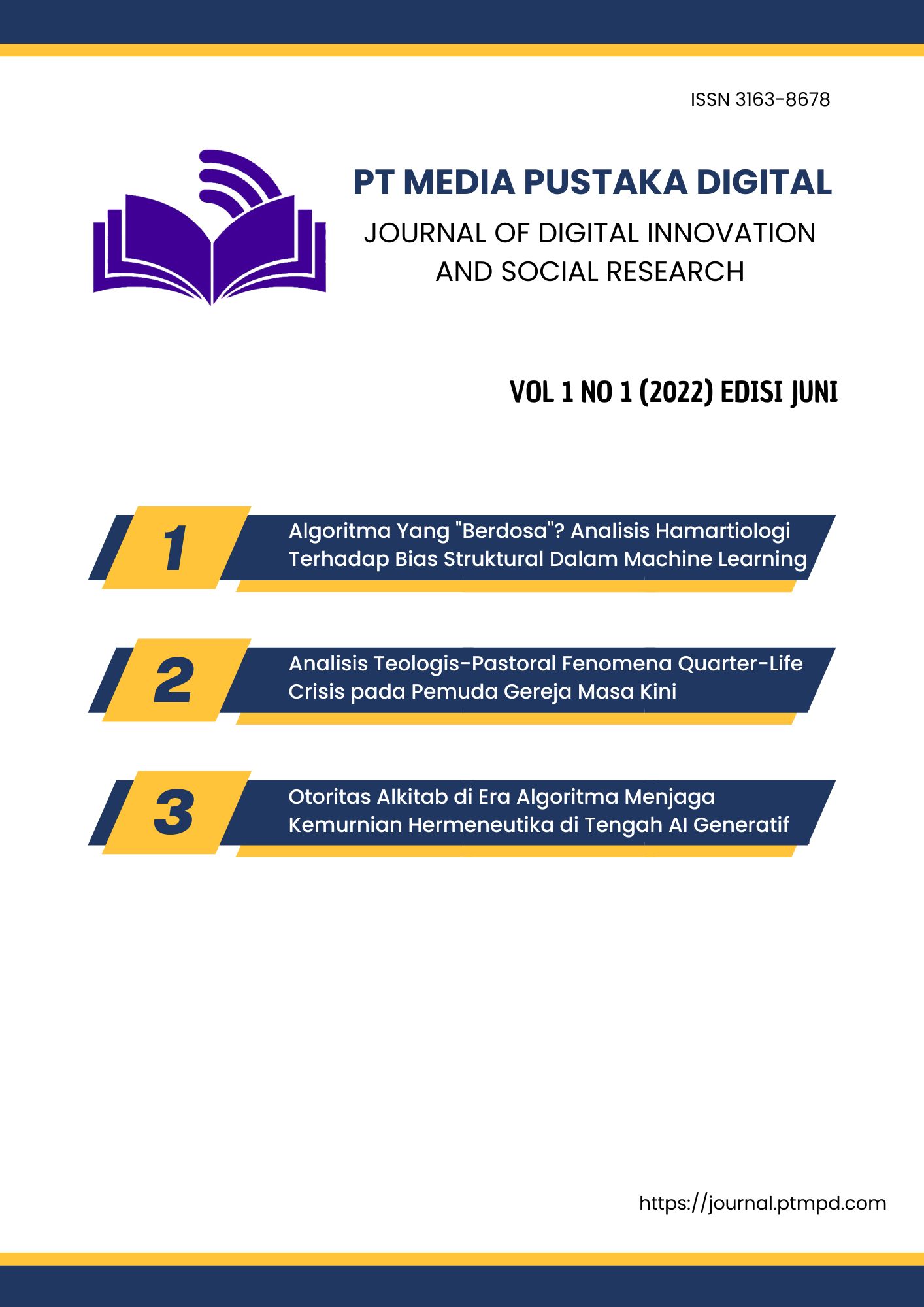
Biblical Authority in the Age of Algorithms: Preserving Hermeneutical Purity in the Midst of Generative AI
DOI:
https://doi.org/10.5281/zenodo.21724736Keywords:
Artificial Intelligence, Biblical Authority, Digital Hermeneutics, Evangelical Theology, PneumatologyAbstract
The rapid integration of Artificial Intelligence (AI) into theological landscapes presents both unprecedented opportunities and significant challenges to the traditional understanding of Biblical authority. This study aimed to critically evaluate the implications of using Generative AI (such as ChatGPT) in biblical interpretation and to formulate a theological safeguard based on Evangelical doctrines. This research employed a qualitative method with a library research approach, utilizing a grammatical-historical hermeneutic framework to analyze recent literature (2015–2025) on AI and theology. The results indicated that while AI offers efficiency in data processing and exegetical assistance, it fundamentally lacks the pneumatological dimension (illumination of the Holy Spirit) required for authoritative interpretation. Furthermore, reliance on algorithmic output poses risks of theological bias and hallucinatory exegesis. The study concluded that AI must remain a subservient tool, not a master, within the church's teaching ministry.
Downloads
References
Belo, C. M. F., and H. Y. Natonis. "Sikap Mahasiswa Teologi Terhadap Teknologi." Pengharapan: Jurnal Teologi dan Pendidikan Kristen 2, no. 2 (2025): 31–46.
Bender, Emily M., Timnit Gebru, Angelina McMillan-Major, and Shmargaret Shmitchell. "On the Dangers of Stochastic Parrots: Can Language Models Be Too Big?" Proceedings of the 2021 ACM Conference on Fairness, Accountability, and Transparency, 610–623. New York: ACM, 2021.
Calvin, John. Institutes of the Christian Religion. Edited by John T. McNeill. Translated by Ford Lewis Battles. Louisville: Westminster John Knox Press, 2011.
Campbell, Heidi A. Digital Religion: Understanding Religious Practice in New Media Worlds. London: Routledge, 2021.
Chabata, Lovejoy. "Artificial Intelligence and Afrocentric Biblical Hermeneutics Crossroads in Zimbabwe (Col 2: 8)." HTS Teologiese Studies/Theological Studies 80, no. 1 (2024).
Chicago Statement on Biblical Inerrancy. "The Chicago Statement on Biblical Inerrancy." Journal of the Evangelical Theological Society 21, no. 4 (1978): 289–296.
Erickson, Millard J. Christian Theology. 3rd ed. Grand Rapids: Baker Academic, 2013.
Hertzfeld, Noreen. The Artifice of Intelligence: Divine and Human Relationship in a Robotic Age. Minneapolis: Fortress Press, 2023.
Klein, William W., Craig L. Blomberg, and Robert L. Hubbard Jr. Introduction to Biblical Interpretation. 3rd ed. Grand Rapids: Zondervan, 2017.
Kristyanto, T. H. W., and E. E. Hanock. "Hermeneutika Penyusunan Materi Komsel Gereja Beraliran Pentakostal." Dunamis: Jurnal Teologi dan Pendidikan Kristen 7, no. 1 (2022).
Lennox, John C. 2084: Artificial Intelligence and the Future of Humanity. Grand Rapids: Zondervan, 2020.
Lima, Bruno Cesar, Nizam Omar, Israel Avansi, and Leandro Nunes de Castro. "Artificial Intelligence Applied to the Analysis of Biblical Scriptures: A Systematic Review." Analytics 4, no. 2 (2025): 13–31.
Noble, Safiya Umoja. Algorithms of Oppression: How Search Engines Reinforce Racism. New York: NYU Press, 2018.
Ojieabu, Stanley O. "From Automation to Augmentation: The Potential of Artificial Intelligence in Biblical Hermeneutics." Crowther Journal of Arts and Humanities (2024).
Pantan, Frans. "ChatGPT dan Artificial Intelligence: Kekacauan Atau Kebangunan Bagi Pendidikan Agama Kristen." Diegesis: Jurnal Teologi 8, no. 1 (2023): 108–120.
Pasasa, Adrianus, and Yulius Hartaya. "Perubahan-Perubahan Paradigma Dan Praksis Misi Gereja Di Era Society 5.0." Jurnal Teologi dan Pelayanan Kristiani 5, no. 1 (2021).
Przygoda, Wiesław, Alina Rynio, and Michał Kalisz. "Artificial Intelligence: A New Challenge for Human Understanding, Christian Education, and the Pastoral Activity of the Churches." Religions 16 (2025).
Sutanto, Hery. "Hermeneutika di Era Digital: Tantangan dan Peluang." Veritas: Jurnal Teologi dan Pelayanan 19, no. 2 (2020): 135–150.
Vanhoozer, Kevin J. Is There a Meaning in This Text? The Bible, The Reader, and the Morality of Literary Knowledge. Grand Rapids: Zondervan, 2009.
Zaluchu, Sonny Eli. "Strategi Penelitian Kualitatif dan Kuantitatif Di Dalam Penelitian Agama." Evangelikal: Jurnal Teologi Injili dan Pembinaan Warga Jemaat 4, no. 1 (2020): 28–38.
Zuboff, Shoshana. The Age of Surveillance Capitalism: The Fight for a Human Future at the New Frontier of Power. New York: PublicAffairs, 2019.
Downloads
Published
Issue
Section
License
Copyright (c) 2022 Eiodia Eveline Permata Sari, Theo Pilus Candra (Author)

This work is licensed under a Creative Commons Attribution 4.0 International License.
This journal provides immediate open access to its content on the principle that making research freely available to the public supports a greater global exchange of knowledge.
Articles published in JDISR are licensed under a Creative Commons Attribution 4.0 International License (CC BY 4.0). This license permits anyone to copy, redistribute, remix, transmit, and adapt the work, provided the original work and source are appropriately cited.