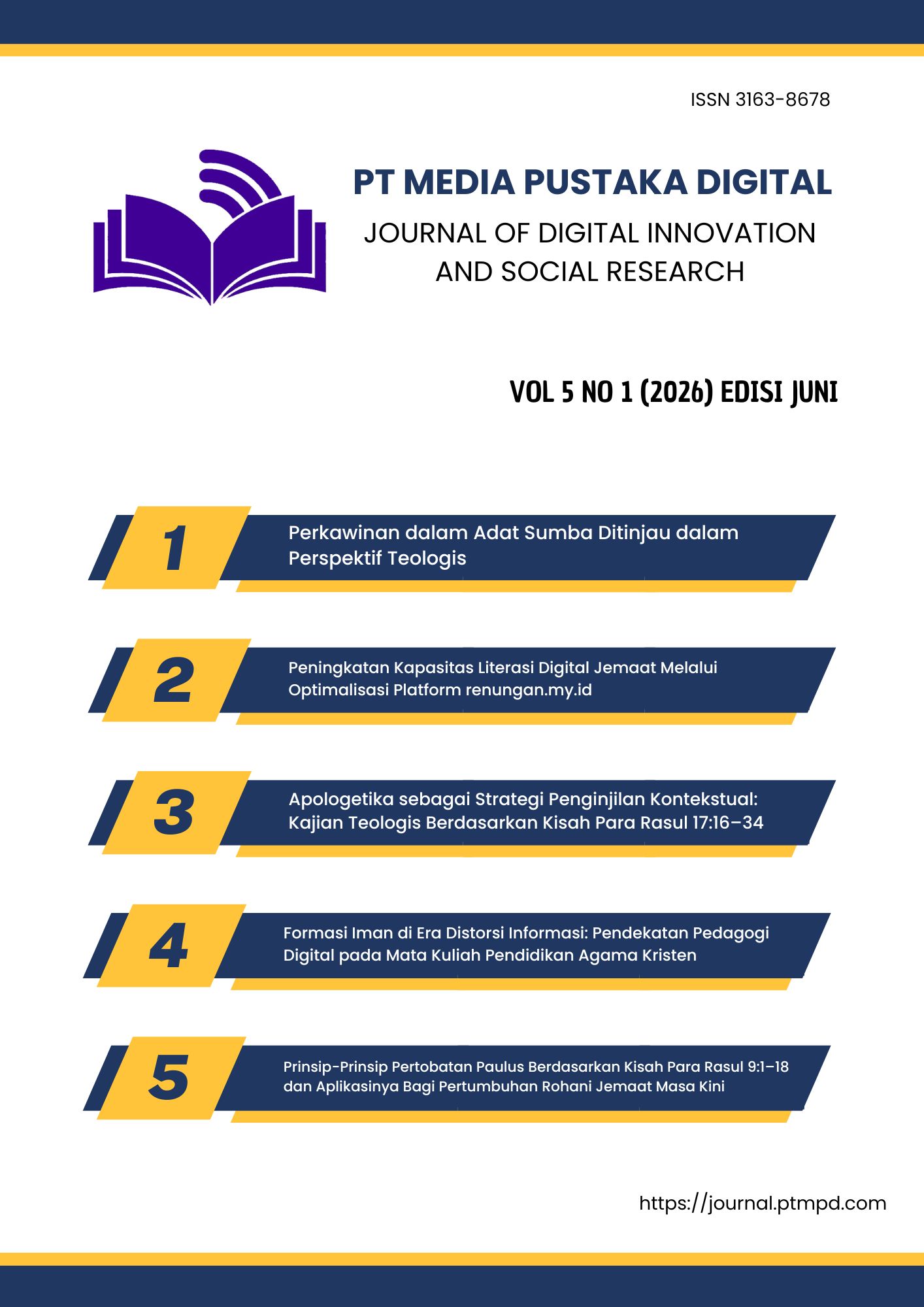
Paul's Principles of Conversion Based on Acts 9:1–18 and Their Application to the Spiritual Growth of the Contemporary Church
DOI:
https://doi.org/10.5281/zenodo.21732296Keywords:
Paul’s conversion, Acts 9:1–18, exegesis, spiritual growth, discipleship, practical theologyAbstract
This study aims to analyze the principles of Paul’s conversion based on Acts 9:1–18 and to examine their implications for the spiritual growth of contemporary church communities. The research employs a descriptive qualitative method with a historical-grammatical exegetical approach and lexical analysis using primary sources such as BDAG and Louw-Nida. The findings reveal that Paul’s conversion represents a holistic transformation process encompassing three major dimensions: cognitive (change of mindset), affective (awareness and remorse for sin), and volitional (commitment to obedience to God). In addition, five key principles of conversion are identified: divine initiative, confrontation with truth, response of obedience, the role of community, and life transformation. The grammatical and lexical analysis of the Greek text reinforces the understanding that conversion is a divine work that is radical in nature and results in observable life transformation. The implications of this study suggest that contemporary churches need to develop spiritual formation models centered on ongoing conversion through discipleship, transformative preaching, and strong faith communities. Therefore, conversion should not be understood merely as an initial experience but as a dynamic process that serves as the foundation for spiritual growth.
Downloads
References
Bosch, David J. Transforming Mission: Paradigm Shifts in Theology of Mission. 20th Anniversary Edition. Maryknoll, NY: Orbis Books, 2011.
Donobakti, and Atmaja. “Pertobatan Sebagai Manusia Baru Di Dalam Kristus.” LOGOS: Jurnal Teologi 15, no. 2 (2021): 110–18. https://doi.org/10.54367/logos.v15i2.1480.
Dunn, James D G. The Theology of Paul the Apostle. Grand Rapids, MI: William B. Eerdmans Publishing Company, 1998.
Estefanus, C S, and K Manurung. “Transformasi Kehidupan Paulus Oleh Roh Kudus.” ELEOS: Jurnal Teologi Dan Pendidikan Agama Kristen 4, no. 1 (2023): 40–50. https://doi.org/10.53814/eleos.v4i1.118.
Green, Joel B, Scot McKnight, and I Howard Marshall, eds. Dictionary of Jesus and the Gospels. Downers Grove, IL: InterVarsity Press, 1992.
Laia, K, and M Lawalata. “Strategi Misi Paulus Dalam Konteks Gereja Masa Kini.” JUTIPA: Jurnal Teologi Injili Dan Pendidikan Agama 1, no. 1 (2022): 50–60. https://doi.org/10.55606/jutipa.v1i1.102.
Marshall, I Howard. Acts: An Introduction and Commentary. Tyndale New Testament Commentaries. Downers Grove, IL: InterVarsity Press, 2015.
Pasa, J, and M Yusuf. “Strategi Penginjilan Paulus Dalam Konteks Modern.” Jurnal Teologi Kristen 4, no. 1 (2023): 60–70. https://doi.org/10.38189/jtk.v4i1.893.
Purwoto, and Sumiwi. “Pola Penginjilan Paulus Dalam Kisah Para Rasul.” Jurnal Amanat Agung 1, no. 2 (2020): 80–90. https://doi.org/10.38189/jan.v1i2.71.
Rerung, S. “Spiritualitas Pengampunan Dalam Kehidupan Paulus.” Jurnal Teologi Praktika 3, no. 2 (2022): 60–72.
Silva, Moisés. Biblical Words and Their Meaning: An Introduction to Lexical Semantics. Grand Rapids, MI: Baker Academic, 1994.
Stott, John. The Message of Acts: The Spirit, the Church & the World. Downers Grove, IL: InterVarsity Press, 2014.
Sukardi, Imanuel. Holy Bible: Berkat-Berkat Surat Roma. Surakarta: STT Berita Hidup, 2011.
Wright, N T. Paul and the Faithfulness of God. Minneapolis, MN: Fortress Press, 2013.
Downloads
Published
Issue
Section
License
Copyright (c) 2026 Lewi Eko Sugiharto (Author)

This work is licensed under a Creative Commons Attribution 4.0 International License.
This journal provides immediate open access to its content on the principle that making research freely available to the public supports a greater global exchange of knowledge.
Articles published in JDISR are licensed under a Creative Commons Attribution 4.0 International License (CC BY 4.0). This license permits anyone to copy, redistribute, remix, transmit, and adapt the work, provided the original work and source are appropriately cited.