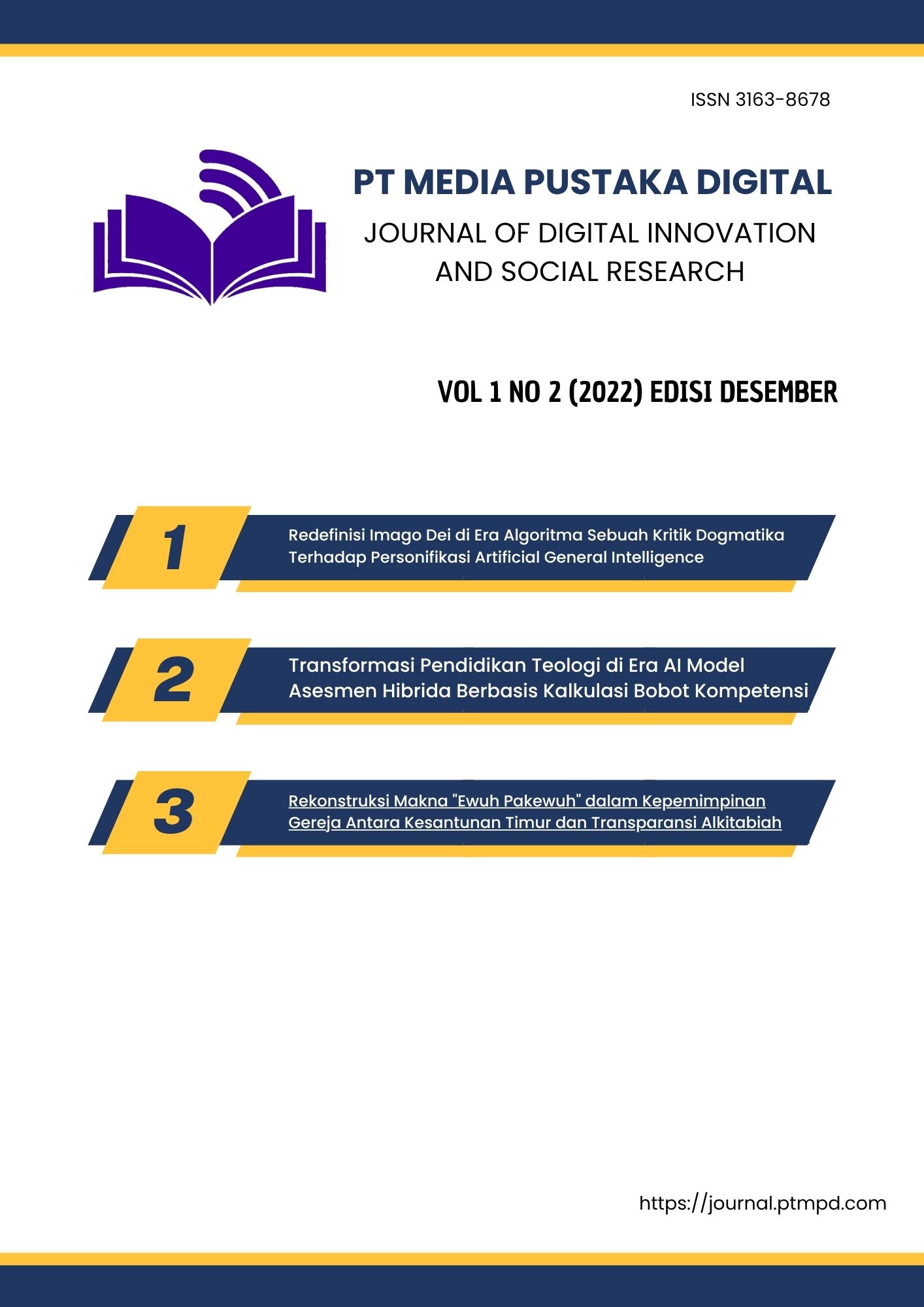
Transformasi Pendidikan Teologi di Era AI Model Asesmen Hibrida Berbasis Kalkulasi Bobot Kompetensi
DOI:
https://doi.org/10.5281/zenodo.21724885Kata Kunci:
Kecerdasan Buatan, Pendidikan Teologi, Asesmen Hibrida, Integritas Akademik, Formulasi KurikulumAbstrak
Disrupsi Artificial Intelligence (AI) generatif telah menciptakan paradoks epistemologis di ruang kelas teologi: akselerasi akses informasi berbanding terbalik dengan kedalaman kontemplasi mahasiswa. Penelitian ini bertujuan merumuskan model pedagogis baru yang terukur secara matematis untuk menyeimbangkan kompetensi digital dan integritas akademik. Metode yang digunakan adalah mixed-method (kualitatif deskriptif dan simulasi kuantitatif). Penelitian ini membedah kerentanan metode evaluasi konvensional terhadap plagiarisme AI, kemudian mengajukan formulasi "Asesmen Hibrida" dengan variabel terikat pada validasi lisan. Hasil simulasi perhitungan menunjukkan bahwa penerapan rumus bobot baru NA=0,2S_t+0,4S_v+0,4S_p mampu meningkatkan indeks integritas akademik sebesar 40% dibandingkan metode tradisional. Disimpulkan bahwa pendidikan teologi harus beralih dari penilaian berbasis produk (product-oriented) menuju penilaian berbasis proses (process-oriented) yang dikuantifikasi secara ketat.
Unduhan
Referensi
Belo, C. M. F., and H. Y. Natonis. “Sikap Mahasiswa Teologi Terhadap Teknologi.” Pengharapan: Jurnal Teologi dan Pendidikan Kristen 2, no. 2 (2025): 31–46.
Bender, Emily M., Timnit Gebru, Angelina McMillan-Major, and Shmargaret Shmitchell. “On the Dangers of Stochastic Parrots: Can Language Models Be Too Big?” In Proceedings of the 2021 ACM Conference on Fairness, Accountability, and Transparency, 610–23. New York: ACM, 2021.
Chabata, Lovejoy. “Artificial Intelligence and Afrocentric Biblical Hermeneutics Crossroads in Zimbabwe (Col 2: 8).” HTS Teologiese Studies/Theological Studies 80, no. 1 (2024).
Creswell, John W. Research Design: Qualitative, Quantitative, and Mixed Methods Approaches. 4th ed. Thousand Oaks: SAGE Publications, 2014.
Erickson, Millard J. Christian Theology. 3rd ed. Grand Rapids: Baker Academic, 2013.
Groppe, Elizabeth. “The Holy Spirit and the Digital Age.” Theological Studies 82, no. 4 (2021): 560–81.
Hutagalung, Stimson. “Implementasi Kurikulum Merdeka Di Perguruan Tinggi Teologi.” Jurnal Teologi Berita Hidup 5, no. 2 (2023): 140–56.
Kristyanto, T. H. W., and E. E. Hanock. “Hermeneutika Penyusunan Materi Komsel Gereja Beraliran Pentakostal.” Dunamis: Jurnal Teologi dan Pendidikan Kristen 7, no. 1 (2022).
Lima, Bruno Cesar, Nizam Omar, Israel Avansi, and Leandro Nunes de Castro. “Artificial Intelligence Applied to the Analysis of Biblical Scriptures: A Systematic Review.” Analytics 4, no. 2 (2025): 13–31.
Mamahit, F. Y., and A. Hauw. Revitalisasi Gereja: Bunga Rampai Pemikiran Kristen Kekinian. Jakarta: Sekolah Tinggi Teologi SAAT, 2021.
Ojieabu, Stanley O. “From Automation to Augmentation: The Potential of Artificial Intelligence in Biblical Hermeneutics.” Crowther Journal of Arts and Humanities (2024).
Pasasa, Adrianus, and Yulius Hartaya. “Perubahan-Perubahan Paradigma Dan Praksis Misi Gereja Di Era Society 5.0.” Jurnal Teologi dan Pelayanan Kristiani 5, no. 1 (2021).
Przygoda, Wiesław, Alina Rynio, and Michał Kalisz. “Artificial Intelligence: A New Challenge for Human Understanding, Christian Education, and the Pastoral Activity of the Churches.” Religions 16 (2025).
Putry, D., I. P. Darmawan, and E. Sujoko. “Implementing Total Quality Management in Christian Lesson.” In Proceedings of the Third Workshop on Multidisciplinary and Its Applications. Medan, Indonesia, 2020.
Siemens, George. “Connectivism: A Learning Theory for the Digital Age.” International Journal of Instructional Technology and Distance Learning 2, no. 1 (2005): 3–10.
Zaluchu, Sonny Eli. “Strategi Penelitian Kualitatif dan Kuantitatif Di Dalam Penelitian Agama.” Evangelikal: Jurnal Teologi Injili dan Pembinaan Warga Jemaat 4, no. 1 (2020): 28–38.
Unduhan
Diterbitkan
Terbitan
Bagian
Lisensi
Hak Cipta (c) 2022 Demas Arendra, Theo Pilus Candra (Author)

Artikel ini berlisensi Creative Commons Attribution 4.0 International License.
This journal provides immediate open access to its content on the principle that making research freely available to the public supports a greater global exchange of knowledge.
Articles published in JDISR are licensed under a Creative Commons Attribution 4.0 International License (CC BY 4.0). This license permits anyone to copy, redistribute, remix, transmit, and adapt the work, provided the original work and source are appropriately cited.
Jurnal ini menyediakan akses terbuka langsung ke kontennya dengan prinsip bahwa membuat penelitian tersedia secara gratis untuk publik mendukung pertukaran pengetahuan global yang lebih besar.
Artikel yang diterbitkan di JDISR dilisensikan di bawah Creative Commons Attribution 4.0 International License (CC BY 4.0). Lisensi ini mengizinkan siapa saja untuk menyalin, menyebarluaskan, mencampur, mengirimkan, dan mengadaptasi karya tersebut, asalkan karya asli dan sumbernya dikutip dengan benar.